Boiling hand warmers: how long, how often and what to do if one won't start
The hand warmer is lying hard and white in the drawer. It's getting cold outside. And the instructions vanished long ago. Now you're wondering how long it needs in boiling water. Would the kettle do the job too? And why did the last one stay cold after you clicked it?
Here you'll find out how long to boil hand warmers and how to activate them again. You'll also learn how often that works and what helps if one won't start.
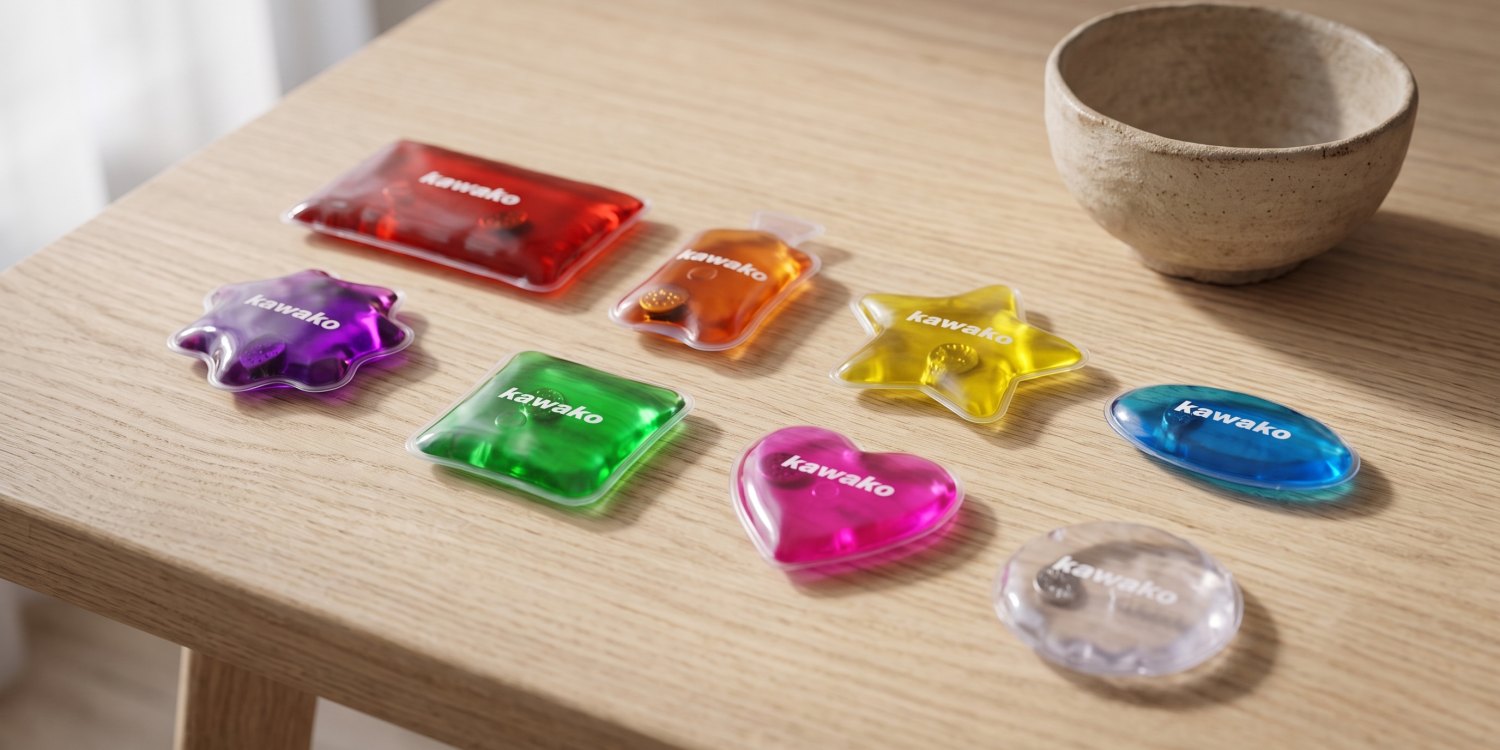 Edited with AI
: The starting point was a real photo of our product. An AI then created the scene around it, such as the table, light and setting. Shape and colour match the product; small differences are possible.
Generated with AI: An AI created this image without a product photo as a template, for example as a mood or in-use image. Shape and colours may differ from the real product.
How does a pocket warmer work?
Inside a pocket warmer is a gel filling made of sodium acetate and water. In other words, a salt solution. There's also a small metal disc. As long as the gel is clear and liquid, it has stored heat. When you click the disc, the filling starts to crystallise and releases this heat. Within a short time, the hand warmer reaches about 50 °C.
After a while, all the gel has turned solid and the warmer slowly cools down. When you boil it, the crystals dissolve again. The gel turns liquid once more and stores new heat. That's why you can use the same hand warmer again and again. No battery, no plug socket.
What's inside a hand warmer, and is it toxic?
Sodium acetate is harmless. It's even approved as the food additive E262. You'll find it as an acidity regulator in many tinned fruits, vegetables, fish and salads, for example. Even so, the filling isn't meant to be eaten.
If children use the pocket warmer on their own, keep an eye on them anyway. Grown-ups should do the boiling and taking out, because the water and the warmer are hot. Once activated, the warmer also reaches around 50 °C. So for children, it's better in a coat pocket or a cover rather than lying directly on the skin for a long time. Biting, cutting and poking are off limits, as the casing can split open. And if a warmer leaks, take it away straight away.
Boil, activate, reuse
The whole cycle of your hand warmer at a glance.
How long do you need to boil hand warmers?
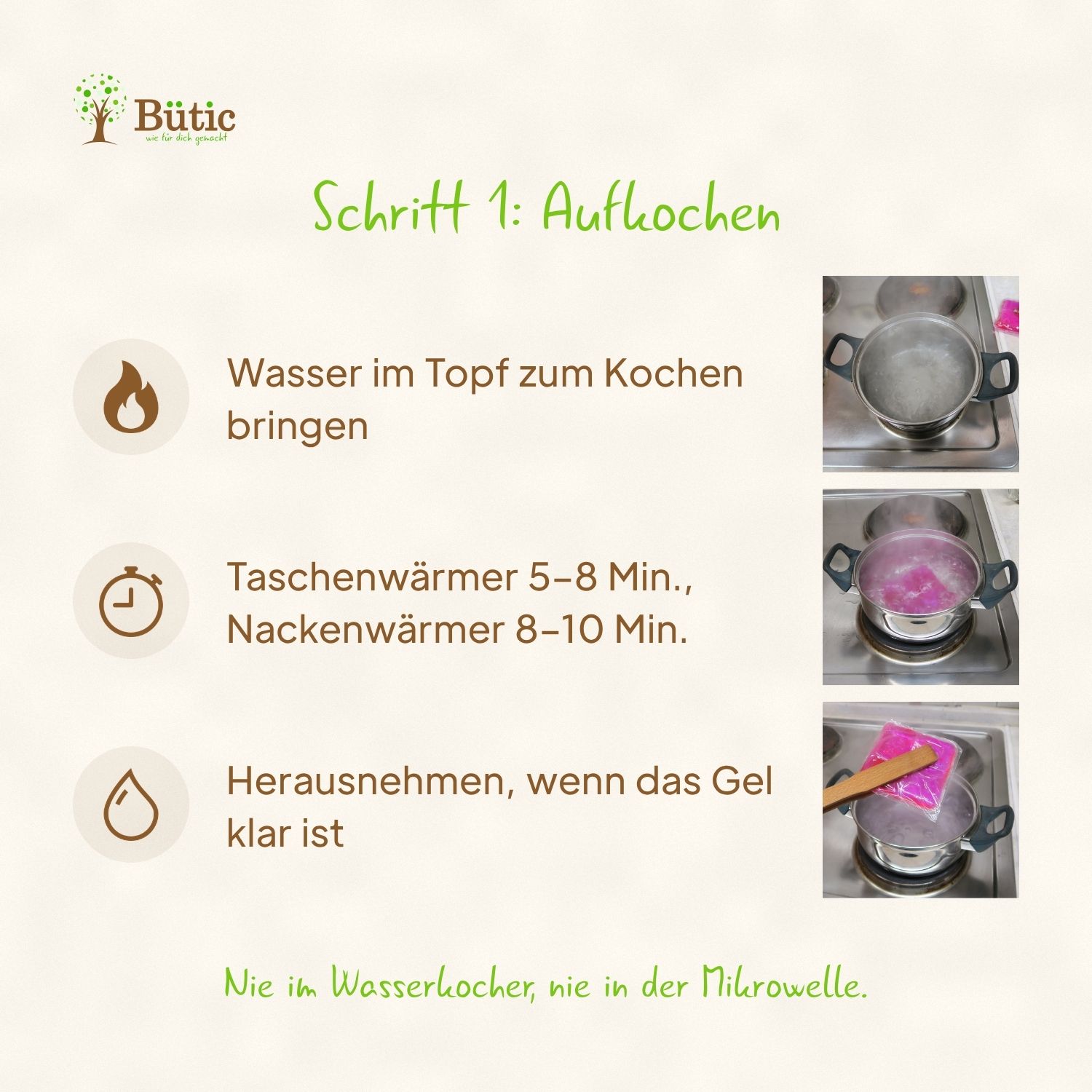
A used hand warmer is hard. Whether you call it reheating, recharging or resetting, it always means boiling. To make it liquid again and activate it once more, you boil it. Keep going until the gel is completely clear and liquid. As a guide: pocket warmers about 5 to 8 minutes, neck warmers 8 to 10 minutes, at a constant boil. Here's how:
- Bring water to the boil in a pan.
- Put the hardened hand warmers into the boiling water.
- Keep pocket warmers at a constant boil for about 5 to 8 minutes and neck warmers for 8 to 10 minutes. The crystals only dissolve from around 58 °C. So the water really has to boil.
- Take them out as soon as the gel is clear and liquid. Use a spoon or kitchen tongs, as the warmers will be hot.
- Leave to cool. The gel stays liquid until you click the disc.
Boil once before first use
Give a new hand warmer a proper boil once before you use it for the first time, too. That way you get the full warming phase from the start. You'll also find all the steps on one page in our instructions as a PDF.
Can you boil hand warmers in a kettle or the microwave?
No. In a kettle, the PVC casing can touch the heating element, and that risk is too high. So always boil your hand warmers in a pan.
The microwave is no substitute for the pan either. Gel-filled hand warmers don't belong in the microwave.
Why does the hand warmer go hard again straight after boiling?
Usually a small amount of crystals is still left in the gel. Even a tiny crystal is enough, and everything turns solid again as it cools. So boil the warmer until you can't see any white patches. Then let it cool in peace. Don't press on the metal disc while it cools, not even with a spoon or tongs. Hard frost from around −10 °C can also set it off by itself. So in winter, don't leave it in the car or outdoors.
What should you do if a hand warmer leaks?
Stop using a leaking or damaged hand warmer, even after boiling it. If it split open while boiling, let the pan and water cool down before you take it out. The filling is non-toxic but can leave stains on clothing. If it gets on your skin, simply rinse it off with clean water. Keep it away from eyes and mouth. To keep the casing intact for a long time, keep knives, scissors and sharp fingernails away. And don't press hard on the warmer.
How do you activate hand warmers?
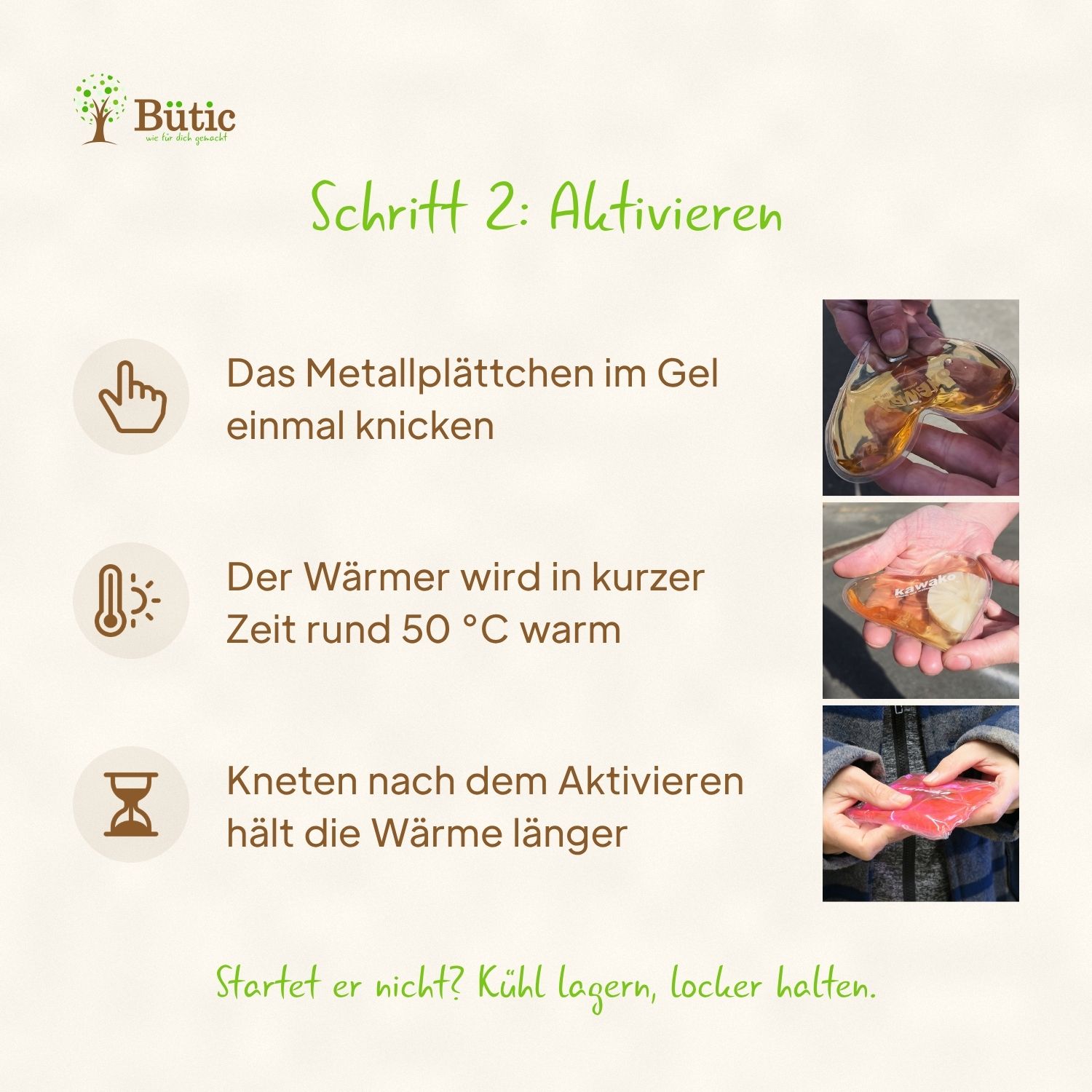
Once the warmer has cooled after boiling and the gel is clear and liquid, give the metal disc inside one quick click. The crystallisation spreads from the disc through all the gel. The warmer heats up within a short time. Two simple tricks make the warmth last longer:
- Kneading a pocket warmer after activating it extends the warming phase.
- It's best to cover a neck warmer, for example with a towel.
What should you do if the hand warmer won't start?
It's usually down to one of two things. If your fingers push the gel away from the disc as you click it, the starting impulse doesn't reach the gel. So hold the warmer loosely and only click the disc.
Also, the gel is a little sluggish at room temperature. The warmer then doesn't start reliably. So store your hand warmers somewhere cool before you use or test them. If the gel has already turned solid in places, simply boil the warmer again.
Can you activate a hand warmer without the disc?
Not on purpose. The disc is the start button. Clicking it creates tiny crystals at the rough bend, and from there all the gel turns solid. No other crystal can reach the gel through the casing. And you shouldn't cut the casing open. If the warmer won't start despite clicking, the tips above usually help: store it cool and hold it loosely.
How often can you use a hand warmer?
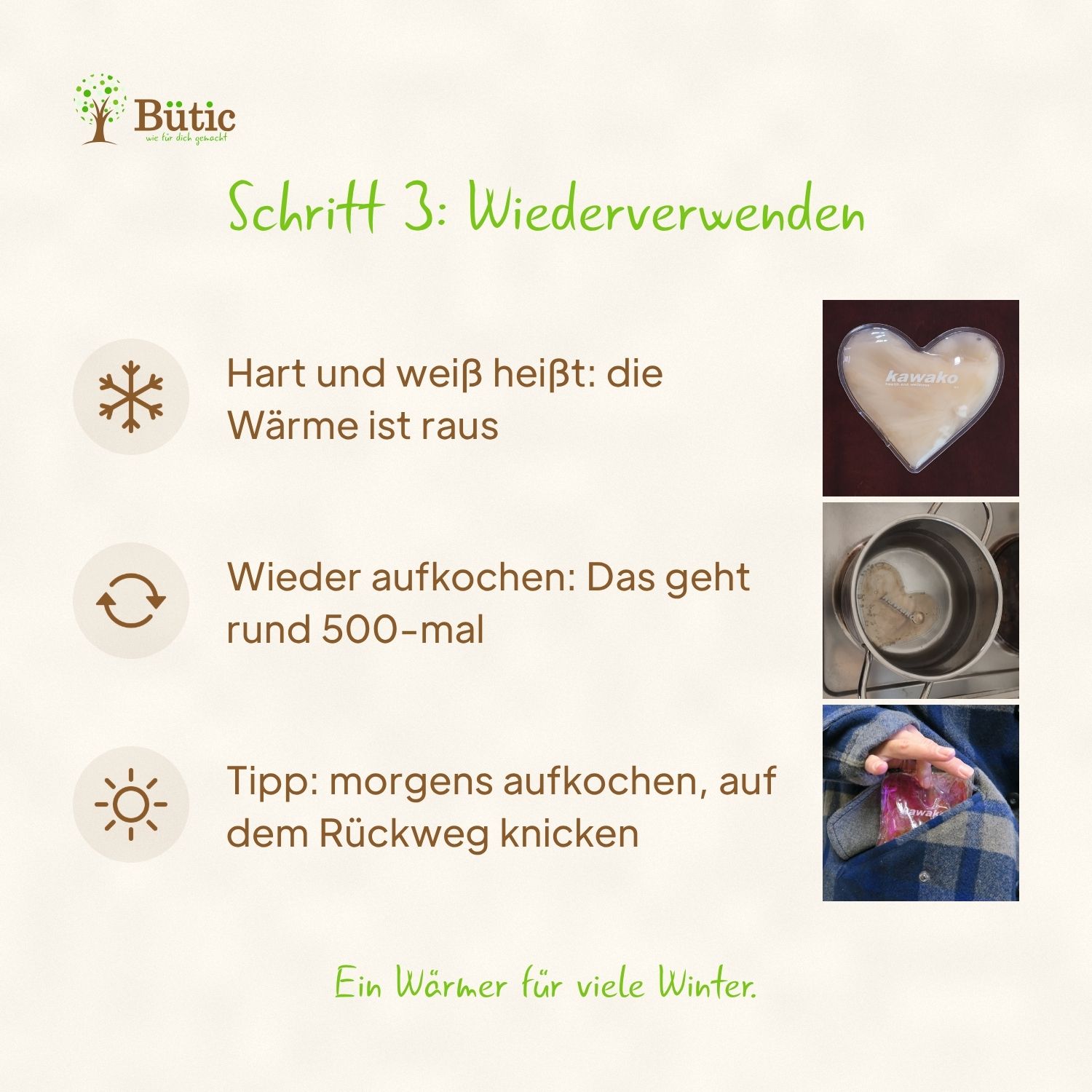
A pocket warmer can be boiled and reused about 500 times. For our shoulder and neck warmer, the manufacturer even states up to 1,000 cycles. So a single warmer will see you through many winters, and you won't need to keep buying disposable warmers.
A really hot tip for when you're out and about
Can't boil your hand warmers during the day? Then boil them in the morning just before you head out. Let them cool until you can hold them comfortably, then pop them in your pocket. The leftover heat from boiling keeps you warm on the way there, without activating the warmers. On the way back, you click the disc and get warm hands a second time.
How long does a pocket warmer stay warm?
There's no fixed number of minutes. How long a hand warmer stays warm depends on three things:
- the surrounding temperature,
- the size of the warmer,
- and how you use it.
How to get more warmth out of it
In a closed coat pocket, the warmth lasts longer than in a cold hand. Add the two tricks from above: knead it, and cover the neck warmer.
How Bütic makes cold days nicer
At Bütic you'll find pocket warmers in lots of shapes and designs. All have a gel filling and are made for boiling. They fit in any coat or trouser pocket. And they make a small gift that lasts all winter.
- Sets of 8 in shapes such as hearts, stars, flowers or hot water bottles
- Smiley hand warmers in a set of 4 in four colours and the hot water bottle in a set of 4 in matt red
- Winter designs such as the polar bear, the penguins in a set of 2 or the snowman in a set of 6
- Hand warmers with a knitted cover
- the shoulder and neck warmer measuring 43 x 21 cm, in blue or pink
Summary
Boil hand warmers in a pan, never in a kettle or the microwave. Pocket warmers take about 5 to 8 minutes and neck warmers 8 to 10 minutes, until the gel is clear. Stored somewhere cool and given a quick click, they start reliably. And they do so around 500 times.