Wooden music notes: how notes and clefs fit together
You'd like a little melody above the piano, laid out in wooden music notes. You choose Scheme 10 because you want the notes to be about 10 cm tall.
Then a 10 cm treble clef and a 5 cm crotchet lie in front of you. The semibreve measures just 1.2 cm. At first glance it looks as if the sizes have got mixed up.
It isn't a mistake. This is simply how music notation works. Here you'll find out what the four schemes are named after and how tall each note and symbol is. You'll also learn how to plan your music display so it fits your wall.
What the schemes for wooden music notes are named after
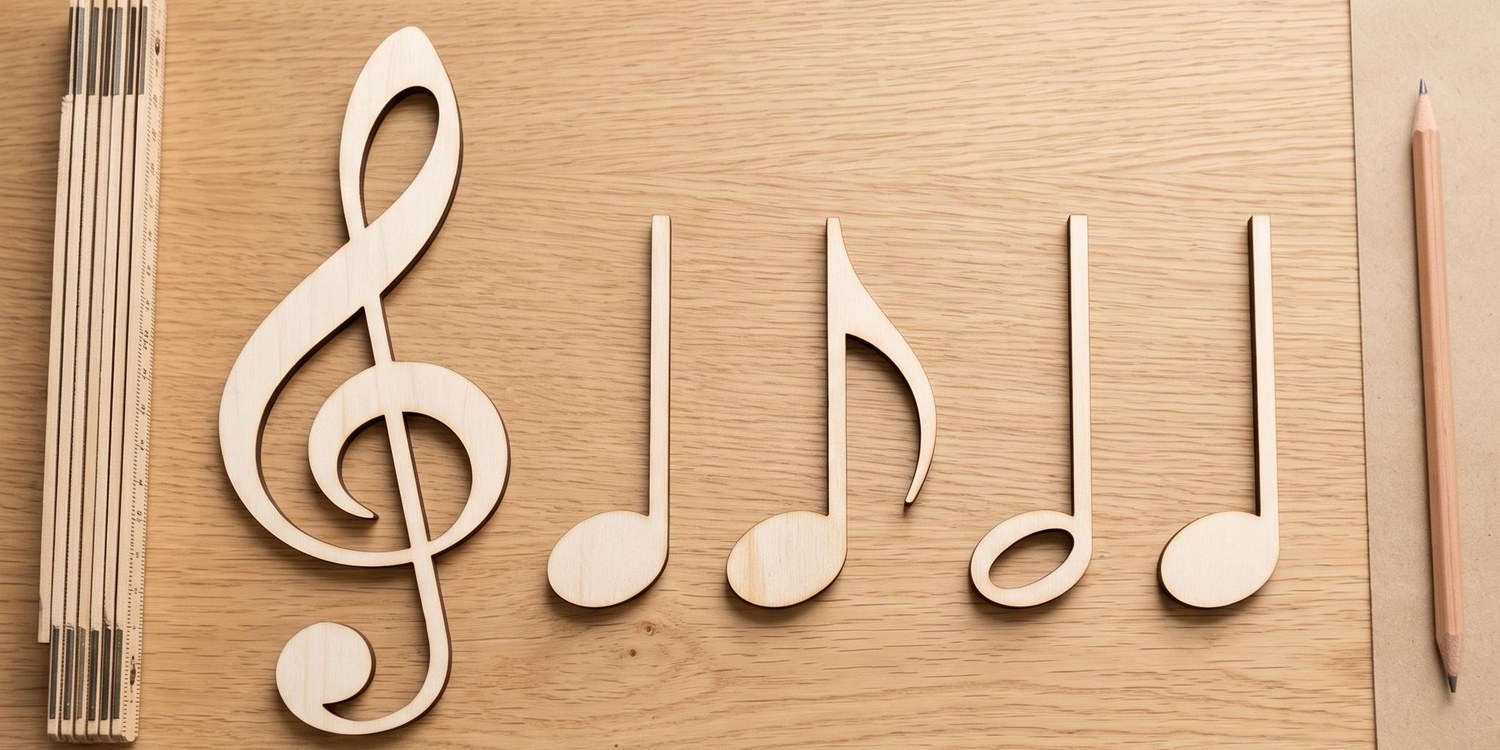
Wooden music notes come in four schemes: 10, 20, 30 and 40. The number gives the height of the treble clef in centimetres. All other symbols in a scheme are scaled to match. They relate to each other just as they do on sheet music.
On sheet music, the treble clef is the largest symbol. It reaches beyond the five stave lines, both above and below. A crotchet, on the other hand, is just a note head and a stem. It is about half as tall. The wooden notes keep exactly these proportions, so your music display looks like printed music.
The height of each symbol is already shown in the selection, for example “Minim 5cm” in Scheme 10. It always means the whole symbol, from its lowest to its highest point.
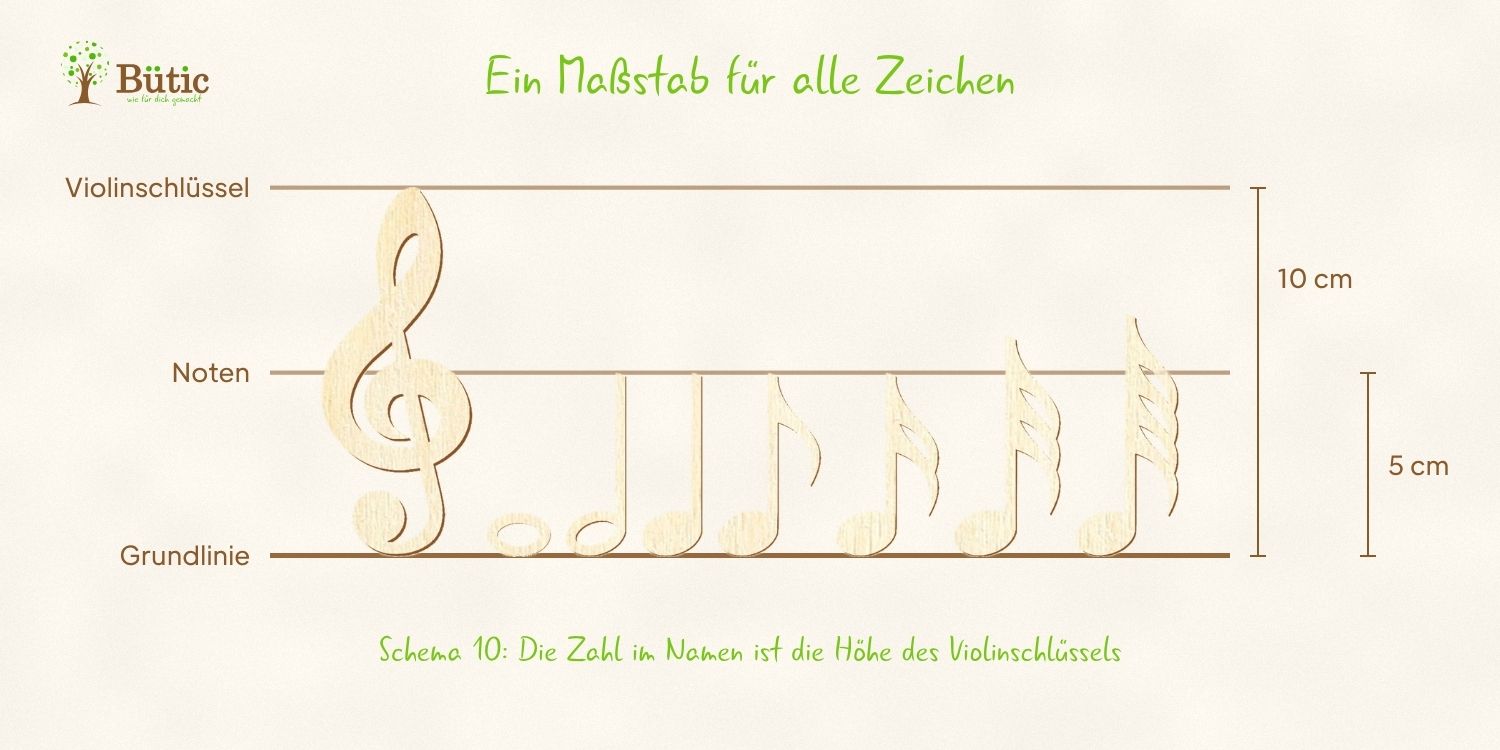
How tall notes and symbols are in the four schemes
Each scheme is a multiple of the first. Scheme 20 is twice the size of Scheme 10, and Scheme 40 is four times the size.
| Symbol | Scheme 10 | Scheme 20 | Scheme 30 | Scheme 40 |
|---|---|---|---|---|
| Treble clef | 10 cm | 20 cm | 30 cm | 40 cm |
| Minim, crotchet, quaver, semiquaver | 5 cm | 10 cm | 15 cm | 20 cm |
| Demisemiquaver | 5.8 cm | 11.6 cm | 17.4 cm | 23.2 cm |
| Hemidemisemiquaver | 6.7 cm | 13.4 cm | 20.1 cm | 26.8 cm |
| Sharp | 4 cm | 8 cm | 12 cm | 16 cm |
| Crotchet rest | 3 cm | 6 cm | 9 cm | 12 cm |
| Semibreve | 1.2 cm | 2.4 cm | 3.6 cm | 4.8 cm |
| Dot | 0.5 cm | 1 cm | 1.5 cm | 2 cm |
These are the values shown in the music notes selection. Semibreve, minim and crotchet marked C are the same height as those without C.
Which music symbols there are
Every scheme has the same 14 symbols: the treble clef, seven note values, three notes with a ledger line and three other symbols. Once you know how they are built, you'll see why their heights differ so much.
Note values from semibreve to hemidemisemiquaver
The semibreve is just an oval note head with no stem. That makes it the smallest note: 1.2 cm in Scheme 10. The minim gets a stem. The crotchet gets a filled-in head. From the quaver onwards, flags hang from the stem: one on the quaver and two on the semiquaver. Minim, crotchet, quaver and semiquaver are all the same height, exactly 5 cm in Scheme 10.
The demisemiquaver has three flags, the hemidemisemiquaver four. To make room for them, the stem gets longer. That's why these two notes are taller than the others: 5.8 and 6.7 cm in Scheme 10.
Notes marked C
On these notes, a short line runs across the note head. This is a ledger line, like the one middle C carries below the five stave lines in the treble clef. They come as semibreve, minim and crotchet. Each is the same height as the same note without the line.
Rest, sharp and dot
The crotchet rest stands for a pause as long as a crotchet. It is 3 cm tall in Scheme 10. The sharp raises a note by a semitone and measures 4 cm. The dot sits to the right of a note and lengthens it by half its value. At 0.5 cm it is the smallest symbol in the scheme.
What does a clef look like?
The treble clef is the best-known clef. It is also called the G clef because it developed from a curly G. Its spiral wraps around the second stave line from the bottom. This shows that the note G sits on that line. All other notes can be read from there. For low notes there is the bass clef. On decorations and gifts, though, you usually see the treble clef.
Its shape is tall and narrow. A wooden clef 10 cm tall is about 4.1 cm wide. So it is not even half as wide as it is tall. If you want to draw a clef, for example on a card, this ratio helps. Set the height first. Then allow just under half of that for the width.
How to plan your wooden music display
Whether it's a melody above the piano, a greeting on a gift or table scatter on a festive table: a few steps make sure everything fits together.
- One display, one scheme: Choose all notes and symbols from the same scheme. If you mix two schemes, the treble clef looks too small or the notes too big.
- Work from the space you have: First measure the maximum height your display can be, for example above a door or on a card. The treble clef is the best guide for this. With 30 cm of space, Scheme 30 is the first choice. Most notes in it are 15 cm tall. If you place some notes higher or lower, for example on painted stave lines, the whole display gets taller. So lay it out as a test first.
- Paint stave lines to go with it: A note head fills exactly the space between two stave lines. So for the line spacing, use roughly the height of the semibreve. That's 1.2 cm in Scheme 10 and 2.4 cm in Scheme 20. Five lines are then just under 5 cm tall in Scheme 10.
- Lay out first, then glue: Lay all the symbols out on the table or on a large sheet of paper before you fix them. That way you can see the spacing and the length of the melody. You can still swap things around.
- Decorate before you hang: Untreated wood takes paint, glue and oil well. It's best to paint the notes before they go on the wall. Let the paint dry thoroughly.
For the music room and the wall above the piano
Schemes 30 and 40 work well on a wall. A 40 cm treble clef is easy to make out even from a few metres away. The notes next to it are 20 cm tall. A short melody of four or five notes is often enough to show anyone coming in that music is made here.
For cards, gifts and the festive table
On a card or a gift for the choir leader, Scheme 10 is just right. The notes are 5 cm tall and easy to glue on. On a festive table for a concert or choir anniversary, the small symbols lie between plates and candles. The dot and the semibreve fill the gaps.
How Bütic helps with your music display
Our music notes and clefs are laser cut here in Pößneck from 3 mm plywood. Each symbol is a separate piece with the typical brown edge. They are untreated, so you can paint, decorate or oil them.
- Music notes and symbols in four schemes, each symbol sold individually: treble clef, seven note values, notes with ledger line, crotchet rest, sharp and dot
- the clef as a separate item in any height from 5 to 40 cm, in 1 cm steps. Its shape differs slightly from the treble clef in the music notes. Its size still matches if you choose the height of your scheme: 10, 20, 30 or 40 cm
- a wooden violin silhouette from 5 to 50 cm
- Wooden letters for a name or a word to go with the melody. You'll find out how tall they are in the article Wooden letter sizes
- If you're not sure which scheme suits your space, tell us what you have in mind via “Question about this item” on the product page. We'll help you choose.
Summary
With wooden music notes, the scheme gives the height of the treble clef. All other symbols are sized to match. That's why the notes are smaller than the number in the name. And that's exactly why your display looks like real sheet music. Take all symbols from one scheme and work from the space you have. Lay everything out once as a test. Then the melody on your wall will be exactly the one you pictured.