Wooden letter sizes: why a lowercase a isn't 10 cm tall
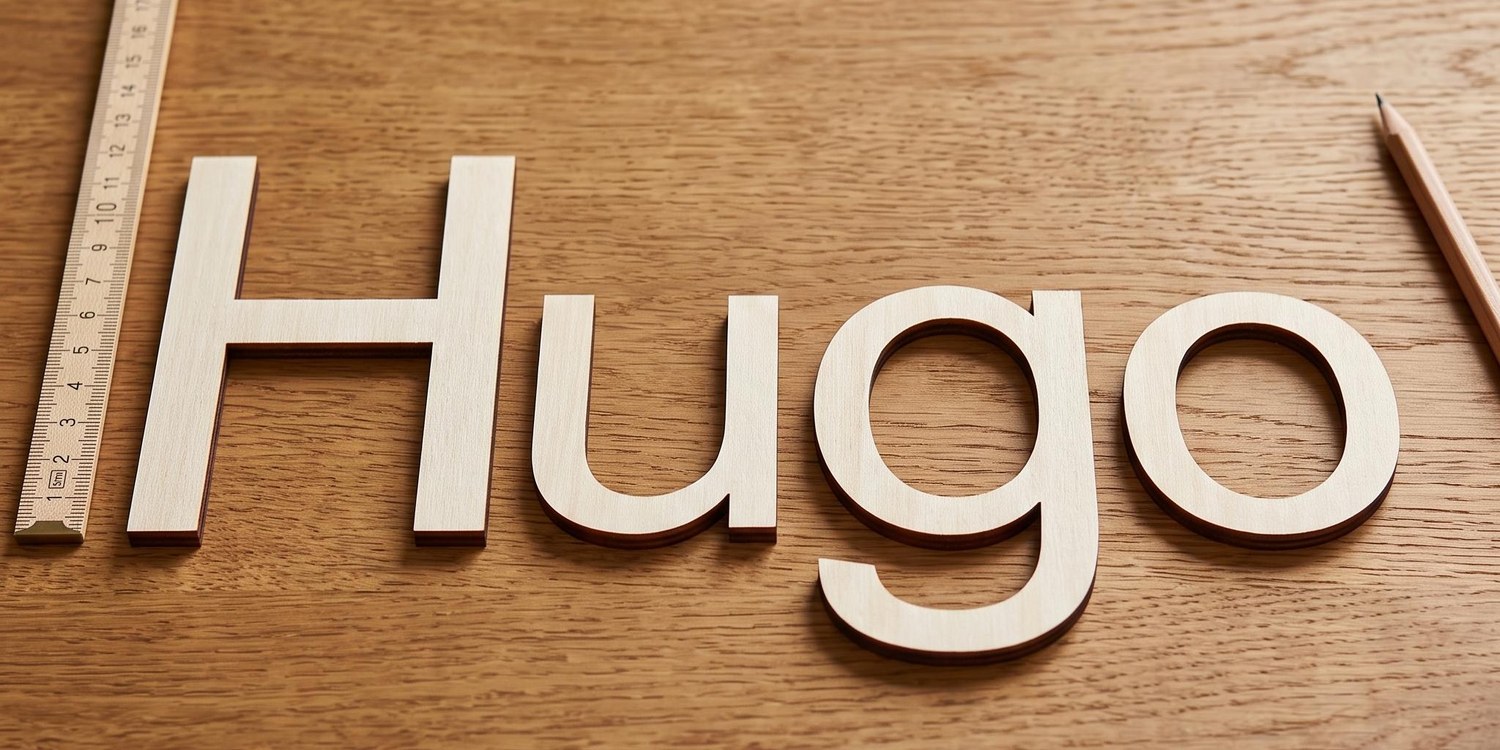
The name for the child's bedroom door is decided. The wooden letters have all been ordered in the 10 cm size. Then H, u, g and o are lying on the table, and only the H seems to be the size you ordered.
The u and the o are noticeably smaller. The g hangs below the others. At first glance, it looks like a mistake in the order.
It isn't. This is simply how type works. Here you'll find out what the size of wooden letters refers to and roughly how tall each letter will be. You'll also learn how to choose the right size for your lettering.
What the size of wooden letters refers to
For plywood wooden letters, the size gives the height of the capital letters. If you choose 10 cm, you get a capital O that is 10 cm tall. This one figure applies to the whole alphabet. All other characters are scaled to match, just as they are designed in the font.
You know this from font sizes on your computer. If you set a text to 12 point, that applies to the whole text. Even so, a lowercase e is shorter than a capital E. Wooden letters work exactly the same way, just in centimetres.
The good news: you don't have to measure each letter separately. If you order a word in one size, all the letters match, whether capital or lowercase.
Why lowercase letters vary in height
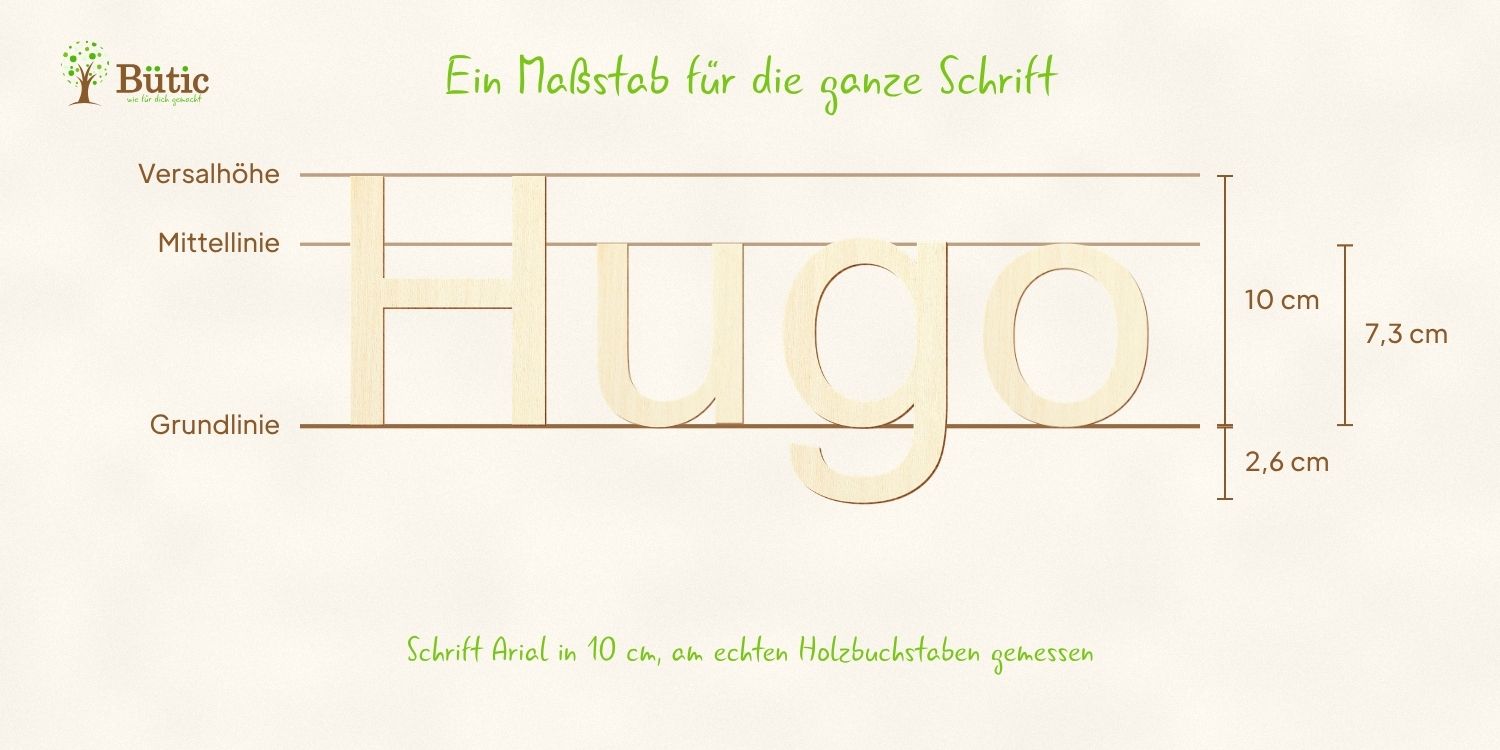
Every font sits on imaginary lines. Capital letters reach from the baseline to the cap height. Lowercase letters fall into three groups, depending on how far they reach up or down. The measurements apply to the Arial font in 10 cm.
x-height: a, c, e, m, n, o, r, s, u, v, w, x and z
These letters only fill the space between the baseline and the mean line. In Arial, that is about three quarters of the height of a capital letter. At 10 cm, a lowercase a is exactly 7.3 cm tall.
Ascenders: b, d, f, h, k, l and t
The stroke of these letters reaches above the mean line, roughly up to the height of the capitals. At 10 cm, a lowercase h is 9.7 cm tall. The i reaches a similar height with its dot.
Descenders: g, j, p, q and y
These letters don't sit on the baseline. They hang a little below it. At 10 cm, a lowercase g is 10 cm tall in total, and about 2.6 cm of that is below the line. With its dot and descender, the j is even the tallest character, about 12.5 cm in Arial.
What if every letter were 10 cm tall?
If every letter were made 10 cm tall on its own, a lowercase o would be as tall as the capital H next to it. The difference between capital and lowercase would be lost. The word would look uneven, as if someone had put together letters from different fonts. That's why all characters share the same scale.
Roughly how tall the letters will be
The values apply to the Arial font. We measured the 10 cm column on real wooden letters. The other sizes have been calculated in the same proportion.
| Symbol | 5 cm | 10 cm | 15 cm | 20 cm |
|---|---|---|---|---|
| Capital letters (measured on the O) | 5 cm | 10 cm | 15 cm | 20 cm |
| x-height, e.g. a, e, o | approx. 3.7 cm | 7.3 cm | approx. 11 cm | approx. 14.6 cm |
| Ascenders, e.g. b, d, h | approx. 4.9 cm | 9.7 cm | approx. 14.6 cm | approx. 19.4 cm |
| Descenders, e.g. g, p, y | approx. 5 cm | 10 cm | approx. 15 cm | approx. 20 cm |
| of which below the baseline | approx. 1.3 cm | approx. 2.6 cm | approx. 3.9 cm | approx. 5.2 cm |
| Dot | approx. 0.7 cm | approx. 1.4 cm | approx. 2.1 cm | approx. 2.8 cm |
Measured in 10 cm: capital O, lowercase a, h and g. All other values are calculated from these and from the font, and rounded. Every font has its own proportions.
And how wide are wooden letters?
The size only describes the height. How wide a letter is depends on its shape, and the differences are big. In Arial at 10 cm, a capital I is only just over 1 cm wide. A capital O is just over 9 cm, and a capital W more than 12 cm. A lowercase a measures 6.4 cm across, a lowercase h 5.7 cm.
For your lettering, this means you can't work out the length of a word from the number of letters. A name with lots of i's and l's will be much narrower than one with M and W.
Flourishes, numbers and special characters
Some fonts have capital letters with flourishes. These swirls may extend beyond the chosen height so that the letter keeps its shape.
Numbers are usually as tall as the capital letters. Small special characters such as a full stop, comma or minus sign are set to the same scale, though. That makes them much smaller than the chosen size. At 10 cm in Arial, a full stop is only about 1.4 cm.
Script fonts and capitals-only fonts
In script fonts, lowercase letters are often even smaller than in Arial. In Hilton Script, a lowercase a at 10 cm is about 6.3 cm tall. In Anatawa it is just under 6 cm.
Some fonts, on the other hand, only come in capital letters, for example Bebas, College Block or Sea Garden. There, all letters are the same height, and the question of lowercase letters doesn't arise at all.
How to choose the right size for your lettering
With a few steps, you'll get a good feel for how your lettering will look before you order.
- One word, one size: Order all the letters of a word in the same size, even if it starts with a capital. That's the only way capital and lowercase letters will match.
- Only lowercase? Go one size up: If your lettering is all lowercase, it will look smaller than the chosen size. If you need letters like a, e or o to be about 7 cm tall, 10 cm is the right size in Arial.
- Room for descenders: If your word contains a g, j, p, q or y, the lettering needs more space at the bottom. In Arial 10 cm, a g reaches about 2.6 cm below the baseline. So for a word like Hugo, allow about 12.6 cm of height in total.
- Do a test print: Type your word on the computer in the font you've chosen and print it out. Enlarge it until the capital O is the height you want. Then you can see the height and length of the whole lettering before you order. Arial and Comic Sans MS are already installed on most computers.
How Bütic makes your lettering look better
Our wooden letters made of poplar plywood are laser-cut in our own production. Each letter is a single piece, 3 mm thick, with the typical brown edge. They are untreated, so you can paint them, decorate them or oil them. Most fonts are available in 5, 10, 15 and 20 cm. We also laser-cut letters from dark real wood veneer and from PLEXIGLAS®.
- Wooden letters in lots of fonts, from Arial to the script font Hilton Script
- Numbers and special characters in Arial and many other fonts, for a date, a house number or an &
- large wooden letters from 25 to 40 cm in the MT font
- self-adhesive wooden letters in the MT font with transparent 3M adhesive tape on the back
- letters made of dark veneer and white PLEXIGLAS® letters, which also come in nine other colours
- a learning alphabet from A to Z with 26 capital letters, up to 30 cm tall
- If you're unsure, send us your word and font using "Question about this item" on the product page. We'll tell you how tall and how wide your lettering will be.
Summary
The size of wooden letters is the height of the capital letters, and it applies to the whole alphabet. That's why most lowercase letters are smaller. Only letters with ascenders or descenders reach the size or go beyond it. It's this shared scale that makes your word look calm and consistent. Order everything in one size and allow for the descenders. If in doubt, do a test print. Then the lettering on your door will be exactly what you pictured.
PLEXIGLAS® is a registered trademark of Röhm GmbH, Darmstadt.