PLEXIGLAS® coloured or opal: 17 colours and their light transmission
You're planning a sign, a lamp or a privacy screen made of PLEXIGLAS® and need to choose a colour. On screen, opal PLEXIGLAS® and white look almost the same. And no product photo tells you whether a red still lets light through.
Here you can see how much light 17 colours of PLEXIGLAS® GS let through and whether you can see through them. You'll also find out what opal, transparent and opaque mean. And which colour suits which project.
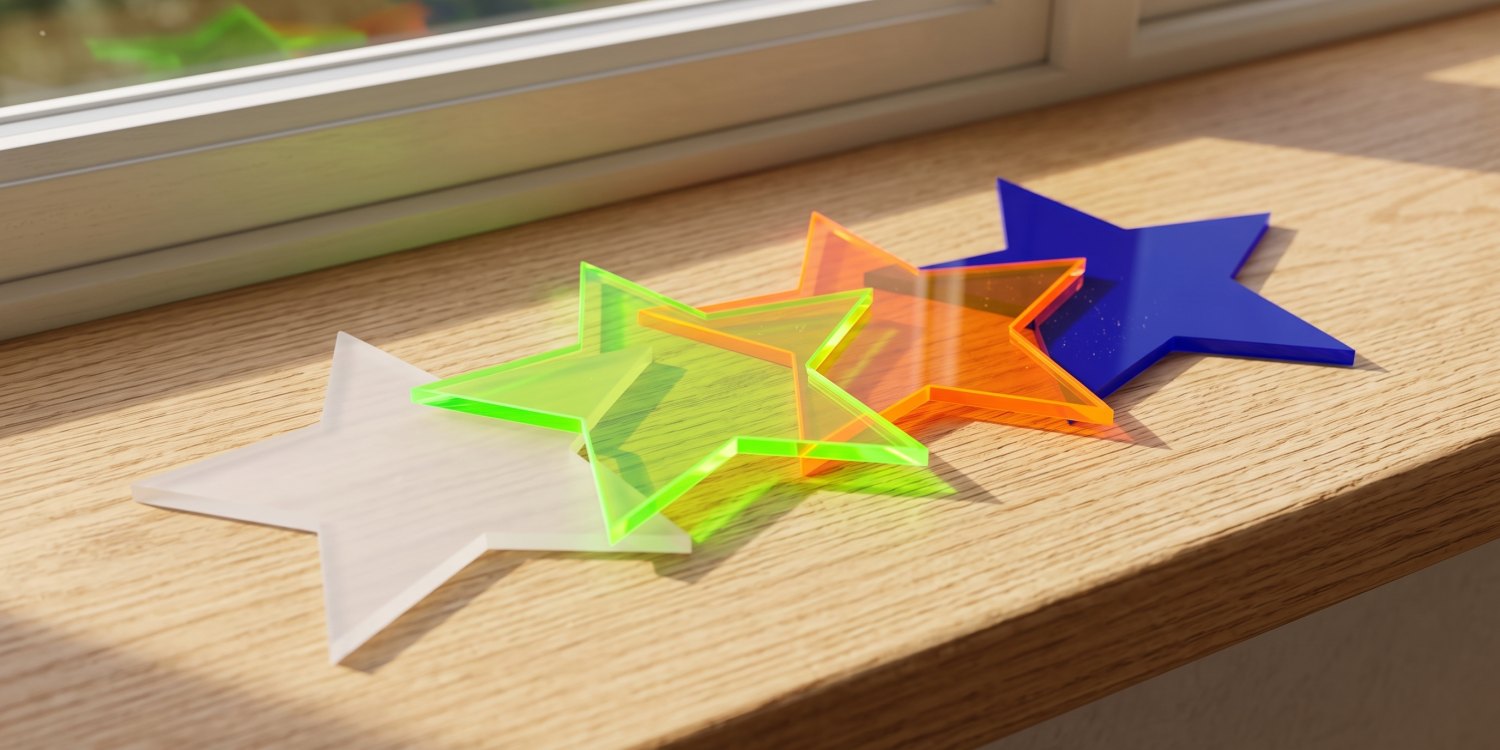 Edited with AI
: The starting point was a real photo of our product. An AI then created the scene around it, such as the table, light and setting. Shape and colour match the product; small differences are possible.
Generated with AI: An AI created this image without a product photo as a template, for example as a mood or in-use image. Shape and colours may differ from the real product.
What does light transmission mean for PLEXIGLAS®?
Light transmission tells you what percentage of light passes through the sheet. At 0%, nothing gets through and the sheet is opaque. The higher the value, the brighter the sheet looks in front of a lamp or at a window. Three groups help you choose:
- See-through: You can see clearly through it, even if the sheet is tinted. This includes colourless transparent, dark grey transparent and the three neon colours.
- Opal: Lots of light gets through, but you can't see clearly. The light is diffused and the sheet glows brightly.
- Solid colours: They look like a coloured surface, such as white, red, blue or black. You can't see through them. Cream, yellow and green still let some light through in front of a lamp. Most others let hardly any through, grey almost none and black none at all.
Letting light through doesn't mean see-through
The percentage tells you how much light gets through the sheet. It doesn't tell you whether you can see through it. Neon red transparent and cream both let 27% of the light through. You can see clearly through neon red, everything just looks tinted red. Cream spreads the light inside the sheet, so you can't make out anything behind it. That's why the table also shows whether you can see through each colour.
All 17 colours at a glance
Sorted by light transmission, from a lot of light to none at all.
| Colour | Light transmission | See-through | Effect | Colour code |
|---|---|---|---|---|
| Colourless transparent | 92 % | yes | clear as glass | 0F00 |
| Colourless opal | 90 % | no | bright, diffuses the light | WH17 |
| Neon green transparent | 89 % | yes | edges glow | 6C02 |
| Neon orange transparent | 61 % | yes | edges glow | 2C01 |
| Neon red transparent | 27 % | yes | edges glow | 3C02 |
| Cream | 27 % | no | lets light through | 1H02 |
| Dark grey transparent | 21 % | yes | tinted | 7C83 |
| Yellow | 15 % | no | lets some light through | 1H20 |
| Green | 12 % | no | lets some light through | 6H02 |
| Dark green | 7 % | no | hardly any light | 6H01 |
| Orange | 6 % | no | hardly any light | 2H02 |
| Light blue | 5 % | no | hardly any light | 5H51 |
| Blue | 5 % | no | hardly any light | 5H01 |
| White | 3 % | no | almost opaque | WH01 |
| Red | 3 % | no | almost opaque | 3H67 |
| Grey | under 1% | no | almost opaque | 7H32 |
| Black | 0 % | no | opaque | 9H01 |
Colour codes and light transmission according to the manufacturer's data for PLEXIGLAS® GS in 3 mm thickness. According to the manufacturer, they apply equally to thicknesses from 3 to 10 mm.
This is what some of the colours look like on real cutouts.
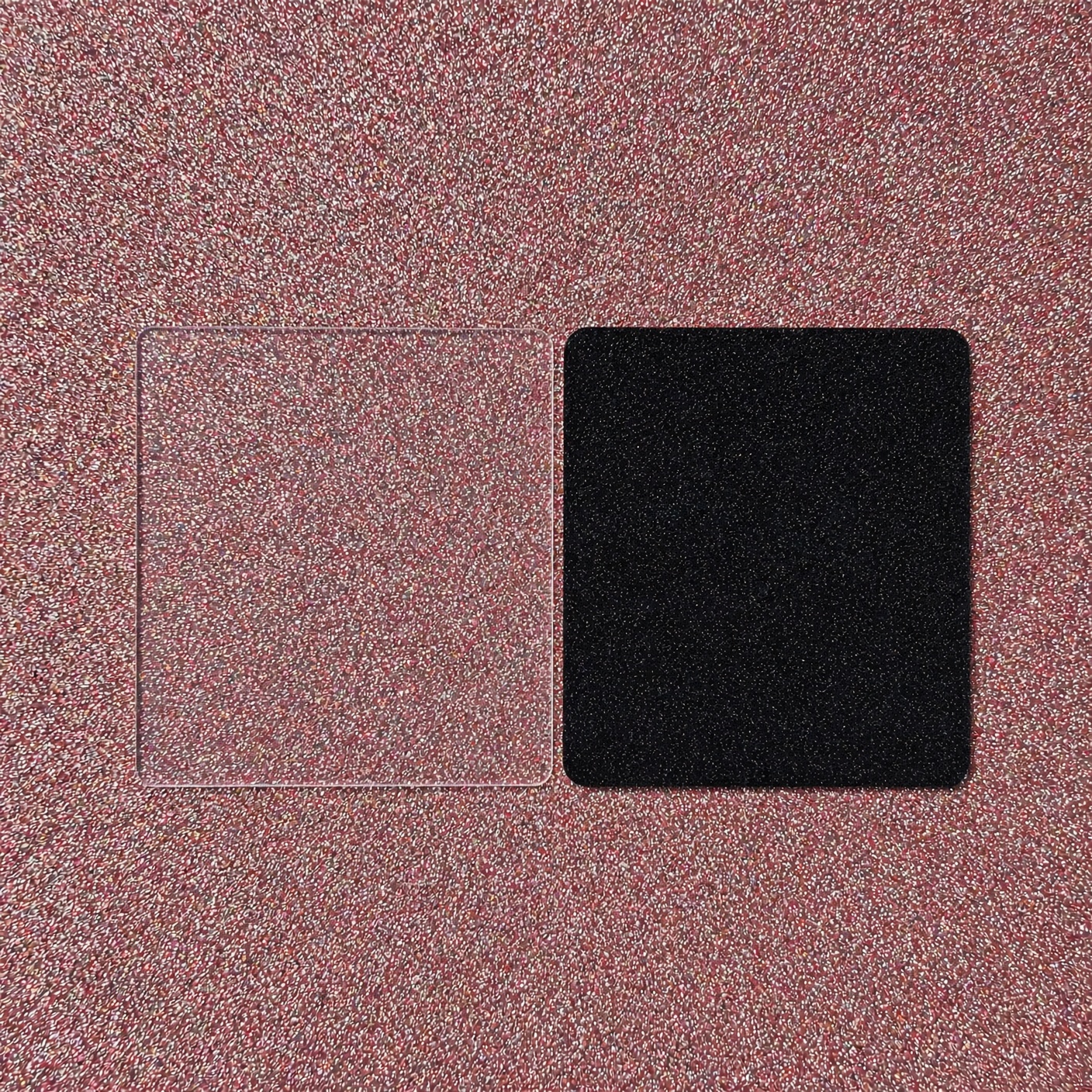
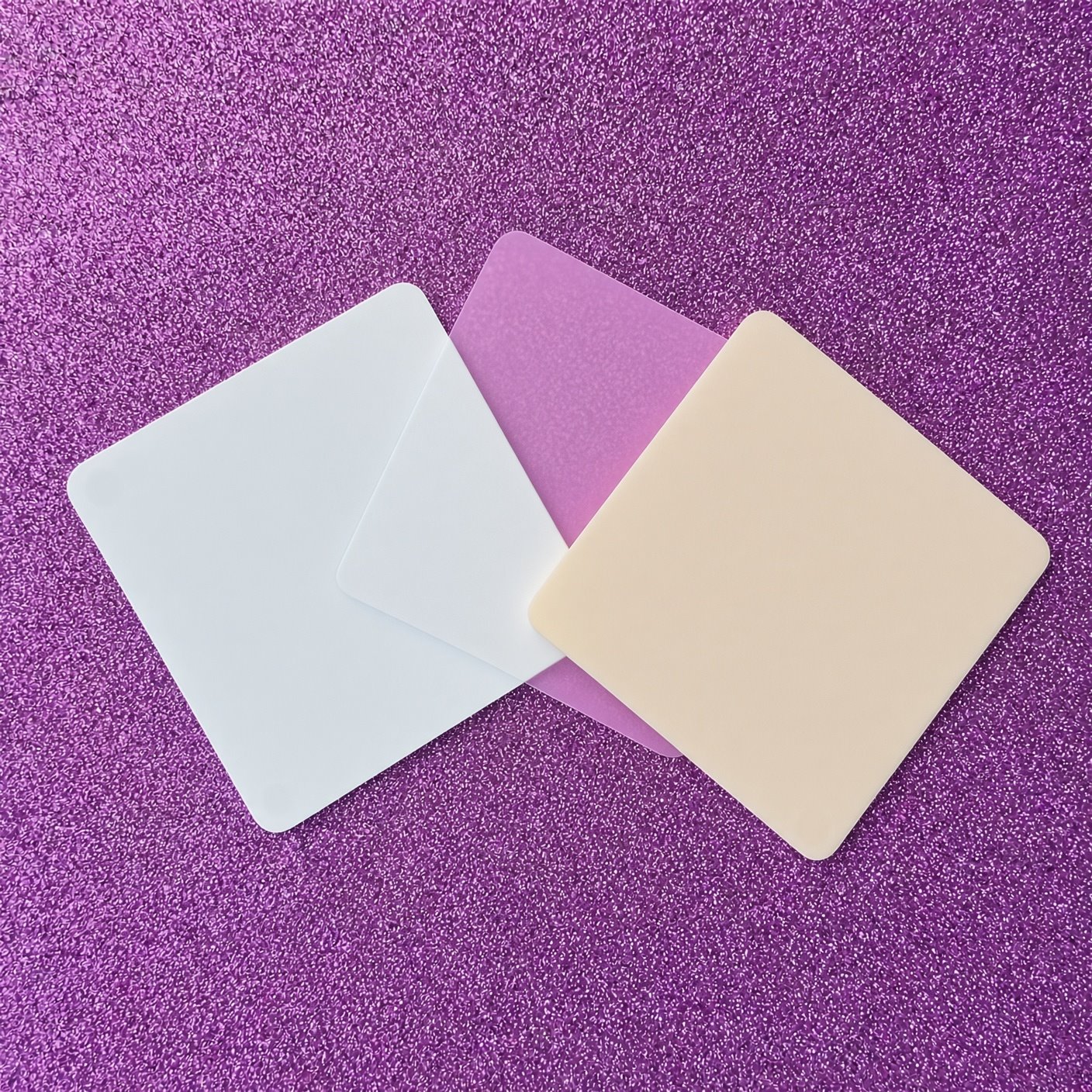
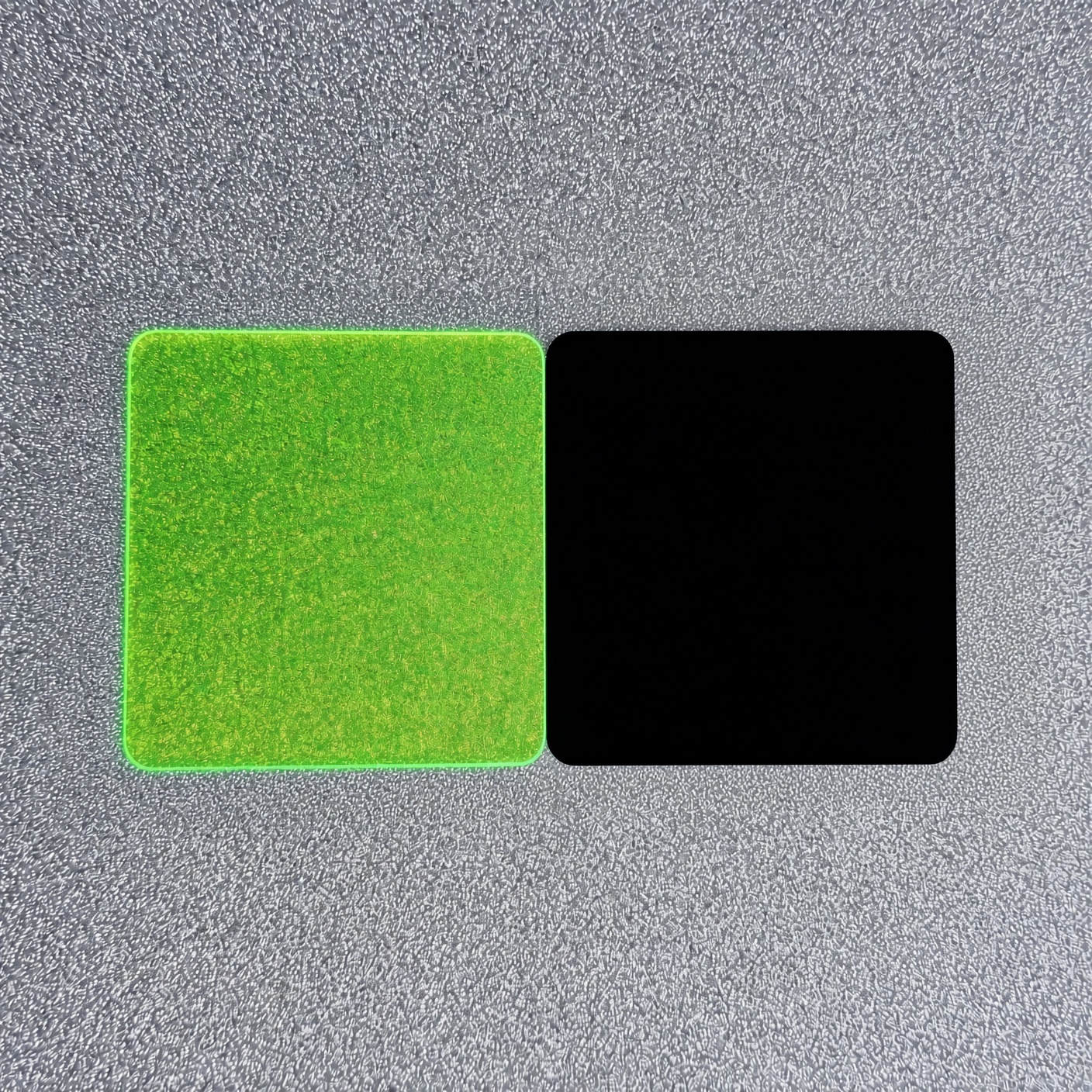
Opal PLEXIGLAS®: light yes, see-through no
Opal PLEXIGLAS® (colour code WH17), often called frosted glass, lets around 90% of the light through. But it diffuses it so strongly that you can't see through it. This applies to this type. According to the manufacturer, other opal sheets let less through, about 70% (WH10) or 44% (WH02). A lamp behind it makes the whole sheet glow brightly. If the lamp sits right against the sheet, you'll see a brighter spot where it is. With a little distance, the light spreads more evenly. Typical uses:
- Light boxes, lampshades and backlit signs
- Privacy screens at the window, in the bathroom or as a room divider that still lets in light
- Window decorations that soften the daylight
Opal or white?
Both look similar in daylight. In front of a lamp, though, they behave completely differently. Opal PLEXIGLAS® lets around 90% of the light through, white (WH01) only about 3%. For anything that should glow, opal is the right choice. For an opaque, solid white, the solid colour is the better option.
Opal or satin?
Both are often called frosted glass, but they're made in different ways. In opal PLEXIGLAS® (WH17), the cloudiness is in the material itself. The surface stays smooth and glossy. Satin acrylic glass, on the other hand, has a matt surface that diffuses the light. Our opal cutouts are glossy.
Is opal PLEXIGLAS® opaque?
Anything further away from the sheet blurs completely. Anything right behind it shows up as a shadow, though. The brighter it is there, the clearer the shadow. For a bathroom privacy screen, this means: during the day, no one can see in. When the light is on inside in the evening, outlines are visible from outside.
Is acrylic frosted glass real glass?
No. Acrylic glass is a plastic, not mineral glass. The name frosted glass only describes the effect: light gets through, but you can't see clearly through it.
Neon colours: why the edges glow
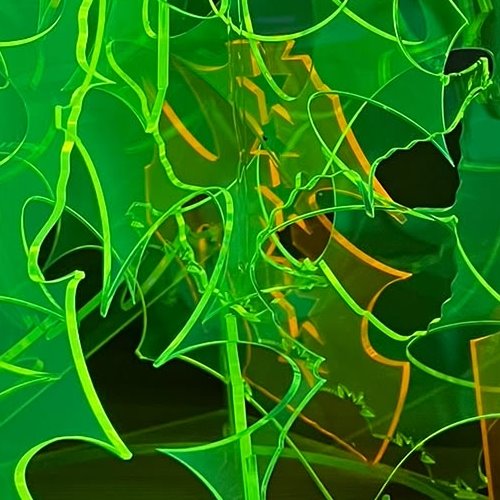
Neon green, neon orange and neon red are coloured with fluorescent dyes. The dyes absorb light that falls on the sheet from the front or from above. They give it off again in their own colour. Part of this light is carried inside the sheet to the edges. That's why the cut edges glow as if lit from within, especially in daylight or under a lamp. The dyes mainly convert UV and blue light. Black light gives off almost only UV light. So under black light in a dark room, neon colours glow especially brightly. Engraved or milled lines glow too, because that's where the light leaves the sheet. Neon colours don't glow in the dark: if no light falls on the sheet, the edges don't glow either.
What neon colours are good for
Signs and notices that need to stand out, window decorations and anything where the edges are part of the design, such as letters, shapes or plant labels.
Cast or extruded: what does GS mean?
PLEXIGLAS® is a brand of Röhm GmbH for acrylic glass. Today the sheets are made by the company Polyvantis. Acrylic glass is made in two ways. Cast acrylic glass, marked GS, is poured in liquid form between two glass plates and hardens there. Extruded acrylic glass, marked XT, is pressed through a nozzle as a continuous strand. All 17 colours in this article are GS.
What this means for you
Laser cutting leaves the cut edges smooth and glossy. On cast acrylic glass, engravings also turn light and matt and stand out clearly. On extruded acrylic glass, they stay almost see-through. That's why GS is especially well suited to signs and cutouts with engraving. You'll find out how to drill and heat-bend GS in our guide Drilling and bending PLEXIGLAS®.
Do the colours last outdoors?
PLEXIGLAS® is weatherproof, frost-resistant and UV-stable. So a plant label can stay in the flower bed all year round. The manufacturer Polyvantis gives a 10-year guarantee on the colour of PLEXIGLAS®. During this time, colour changes should be so slight that you won't notice them under normal viewing. For colourless, transparent PLEXIGLAS® it even guarantees 30 years without yellowing. Both are guarantees from the sheet manufacturer on its material, under its own terms. Heat-bent parts are excluded. You'll find more on this in our guide Drilling and bending PLEXIGLAS®.
Which colour suits which project?
With light transmission in mind, you'll quickly find the right colour:
- Lamp, light box, backlit sign: colourless opal
- Window decorations and suncatchers: colourless transparent, the neon colours or dark grey transparent
- Privacy screen that still lets in light: colourless opal
- Sign with strong contrast: white, black or grey as an opaque base
- Striking edges and glow effects: neon green, neon orange or neon red
- Coloured decorations in front of a wall: any solid colour, only the shade matters here
How to find your colour at Bütic
We laser our PLEXIGLAS® GS cutouts in our own production in Pößneck. They're 3 mm thick and available in all 17 colours in this table. Every shape comes in every one of these colours. You choose the size on the product page. For most shapes, we offer sizes from 3 to 50 cm.
- PLEXIGLAS® cutouts in lots of shapes, from circles and squares to stars and hearts
- PLEXIGLAS® plant labels, colourless or grey transparent, in black or in neon colours
- Suncatchers for the window
- Hole or cut-out: For many cutouts, you can add holes and cut-outs directly on the product page under “Ausschnitte konfigurieren”. We laser them at the same time.
- Your own shape or size: Tell us what you need via Contact. We'll let you know what's possible.
- To keep your cutouts looking good for a long time: Cleaning and caring for PLEXIGLAS®
Summary
For light without seeing through, choose opal. For a clear view, choose colourless transparent. For glowing edges, choose neon, and for solid colour, a solid colour. The table shows you how much light gets through each of the 17 colours and whether you can see through it.
PLEXIGLAS® is a registered trademark of Röhm GmbH, Darmstadt.