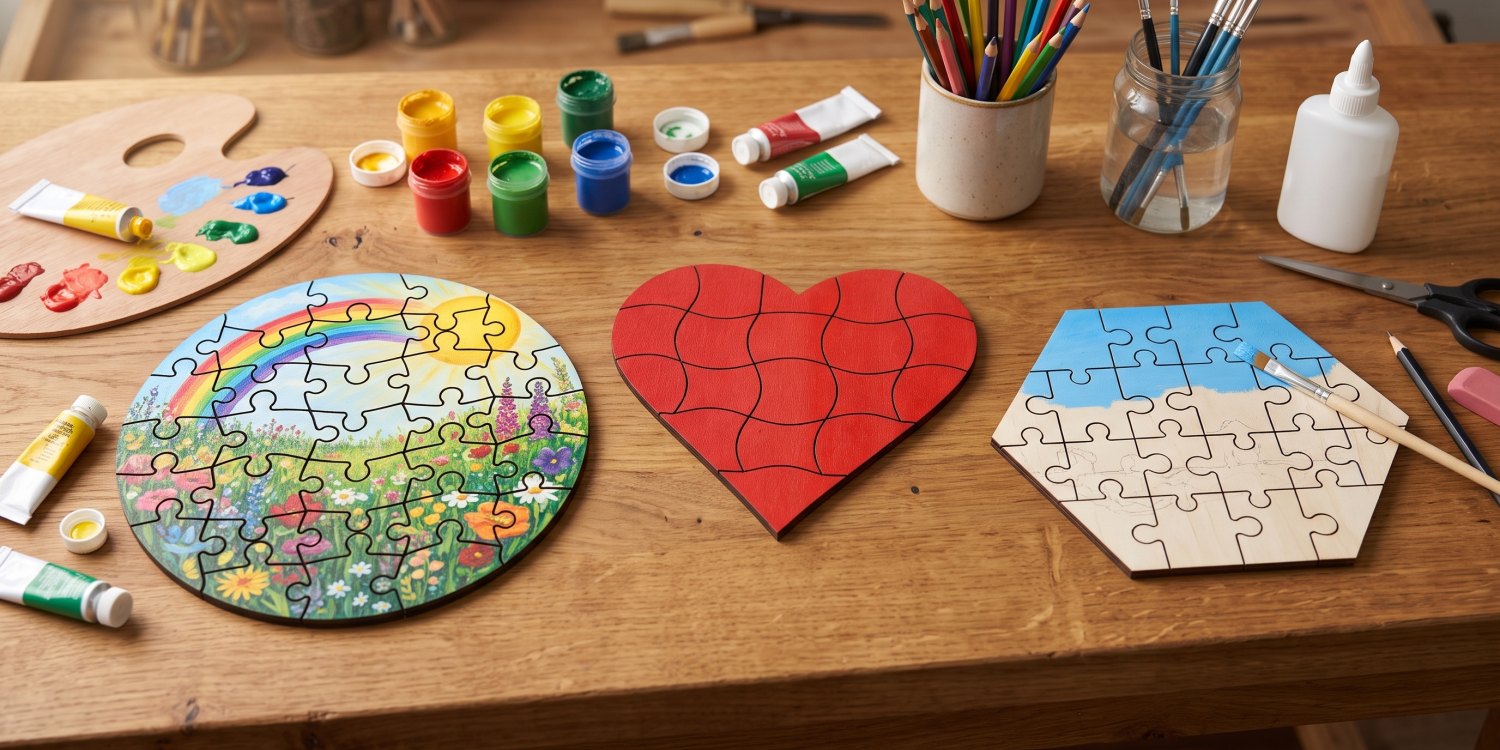
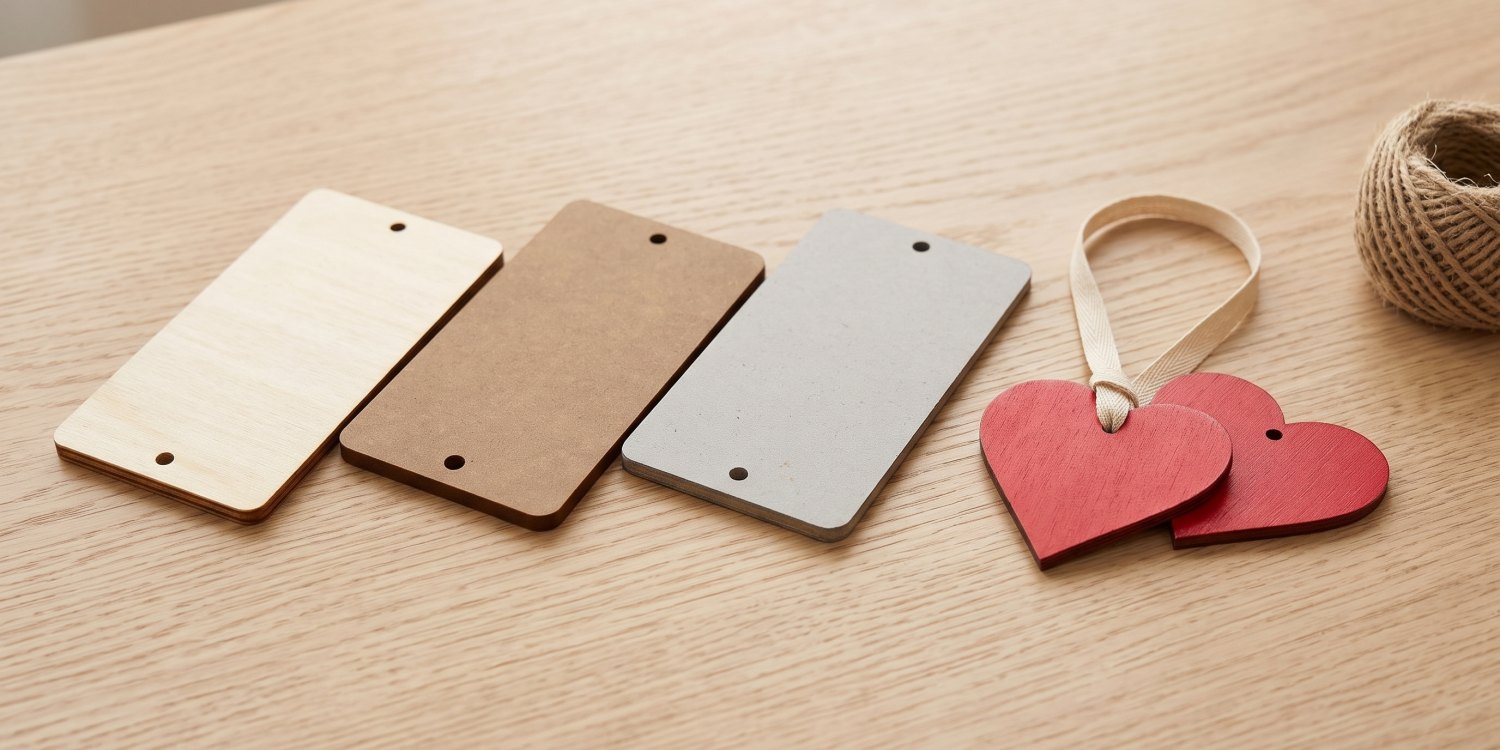
Plywood, HDF, board or felt: which material suits your craft project?
You have the idea: a name sign, window decorations, a mobile or coasters. Then comes the choice. Poplar or birch, HDF or board, maybe felt?
The names tell you little about how a material saws, glues or takes paint. If you pick the wrong one, you only notice while crafting. The paint soaks in patchily, the edge frays, or the piece is too heavy for the mobile.
This overview shows you in a few minutes which material suits which project. It includes the figures that make the difference.
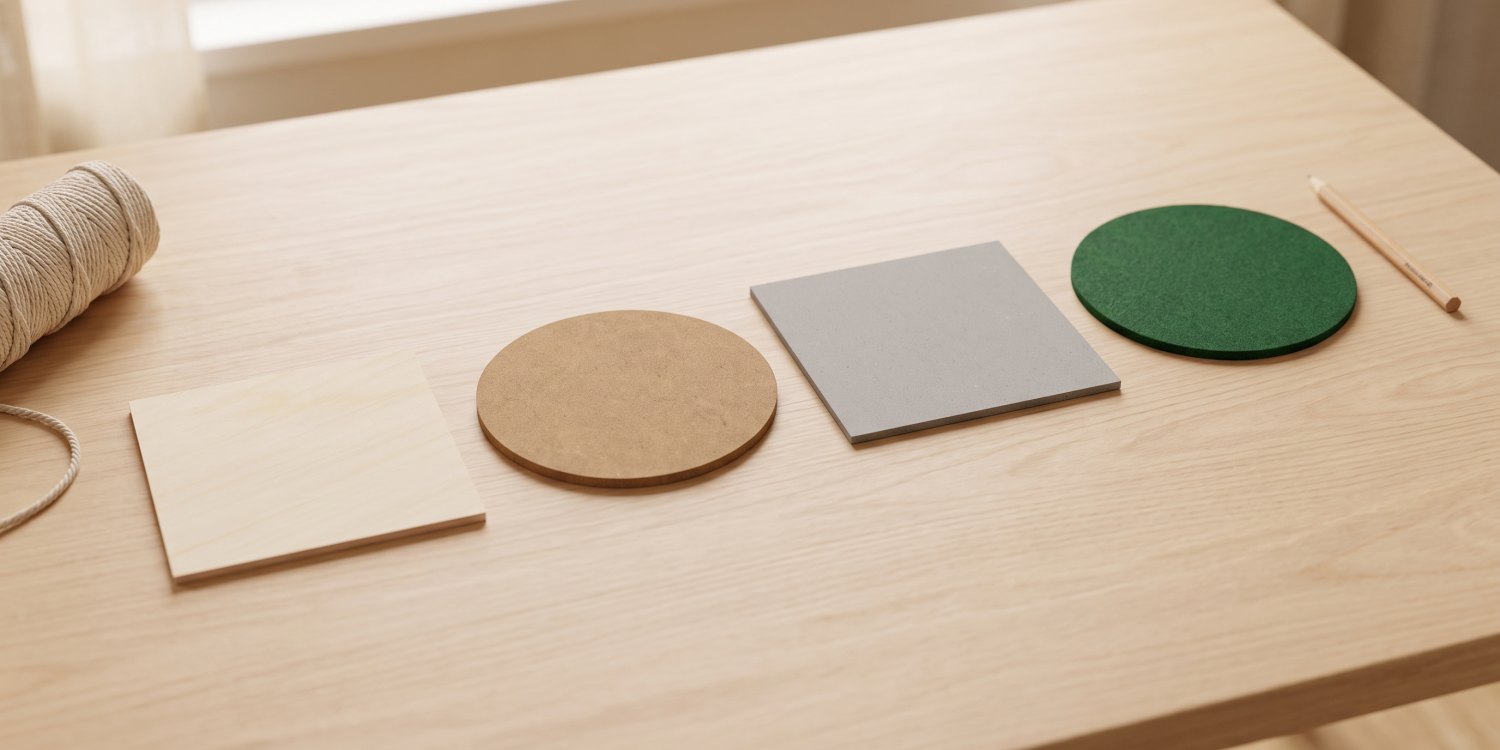 Edited with AI
: The starting point was a real photo of our product. An AI then created the scene around it, such as the table, light and setting. Shape and colour match the product; small differences are possible.
Generated with AI: An AI created this image without a product photo as a template, for example as a mood or in-use image. Shape and colours may differ from the real product.
The five materials compared
Thickness and weight refer to our cutouts.
| Material | Thickness | Weight | Cutting | Painting |
|---|---|---|---|---|
| Poplar plywood | usually 3 mm | approx. 1.2 kg per m² | fretsaw, laser | almost all pens and paints |
| Birch plywood | 3 mm | slightly heavier than poplar | fretsaw with a fine blade, laser | after priming |
| HDF | 3 mm | at least 2.4 kg per m² | saw, router, laser | after light sanding |
| Bookbinder's board | 1.2 mm | 755 g per m² | scissors, craft knife | almost all pens and paints |
| Polyester felt | approx. 2.5 to 3 mm | – | scissors, craft knife | fabric pens, printing |
Weights calculated from: poplar plywood approx. 410 kg per m³, HDF over 800 kg per m³, each at 3 mm thickness.
Light and good for painting: poplar plywood
Poplar plywood is one of the lightest wood materials. The surface is evenly pale with only a very faint grain. Coloured pencils, felt-tip pens, acrylics and watercolours work well on it. So do glazes and stains.
You can shape it easily with a fretsaw. You can join it with wood glue or craft glue. For outdoor use, it needs varnish or a glaze. Find out more: Poplar plywood.
When it needs to be tougher: birch plywood
Birch plywood is denser and sturdier than poplar. It has a pale, decorative grain. Use a fine-toothed saw blade so the edges don't splinter when you saw.
It's worth priming before you paint. Primer makes the wood less absorbent, and the paint sticks better. Find out more: Birch plywood.
Smooth and without grain: HDF
HDF is high-density fibreboard. It is firmer and heavier than MDF, with a smooth, hard surface. Because it has no grain, it doesn't splinter, and the edges come out even.
Before painting, lightly sand the surface and remove the dust. HDF is not waterproof. Find out more: HDF and MDF.
For scissors and craft knives: bookbinder's board
Bookbinder's board is stiff, grey on both sides and only 1.2 mm thick. You can cut it with scissors or a sharp craft knife. Glue sticks well to its rough surface.
It's suitable for book covers, folders and packaging. You can also paint it with almost all pens and paints. Find out more: Bookbinder's board.
Soft and washable: polyester felt
Polyester felt is tear-resistant, stretchy and water-repellent. You can cut it and sew it by hand or machine. You can also glue things onto it, print on it or decorate it with fabric pens.
You can wash it by hand or in the machine. We stock it in 15 colours. Find out more: Polyester felt.
We offer all five as ready-made cutouts
We cut the shapes with a laser. You choose the material, design and size, and you can start creating straight away.
- Wooden cutouts, untreated – poplar plywood for painting
- Birch plywood, coloured
- HDF/MDF cutouts
- Cardboard cutouts
- Felt cutouts
Summary
For painting and for anything that should be light, choose poplar plywood. If it needs to be tougher, go for birch. For smooth, varnished surfaces, choose HDF. For cutting with scissors, use bookbinder's board. And if it should be soft and washable, pick polyester felt.